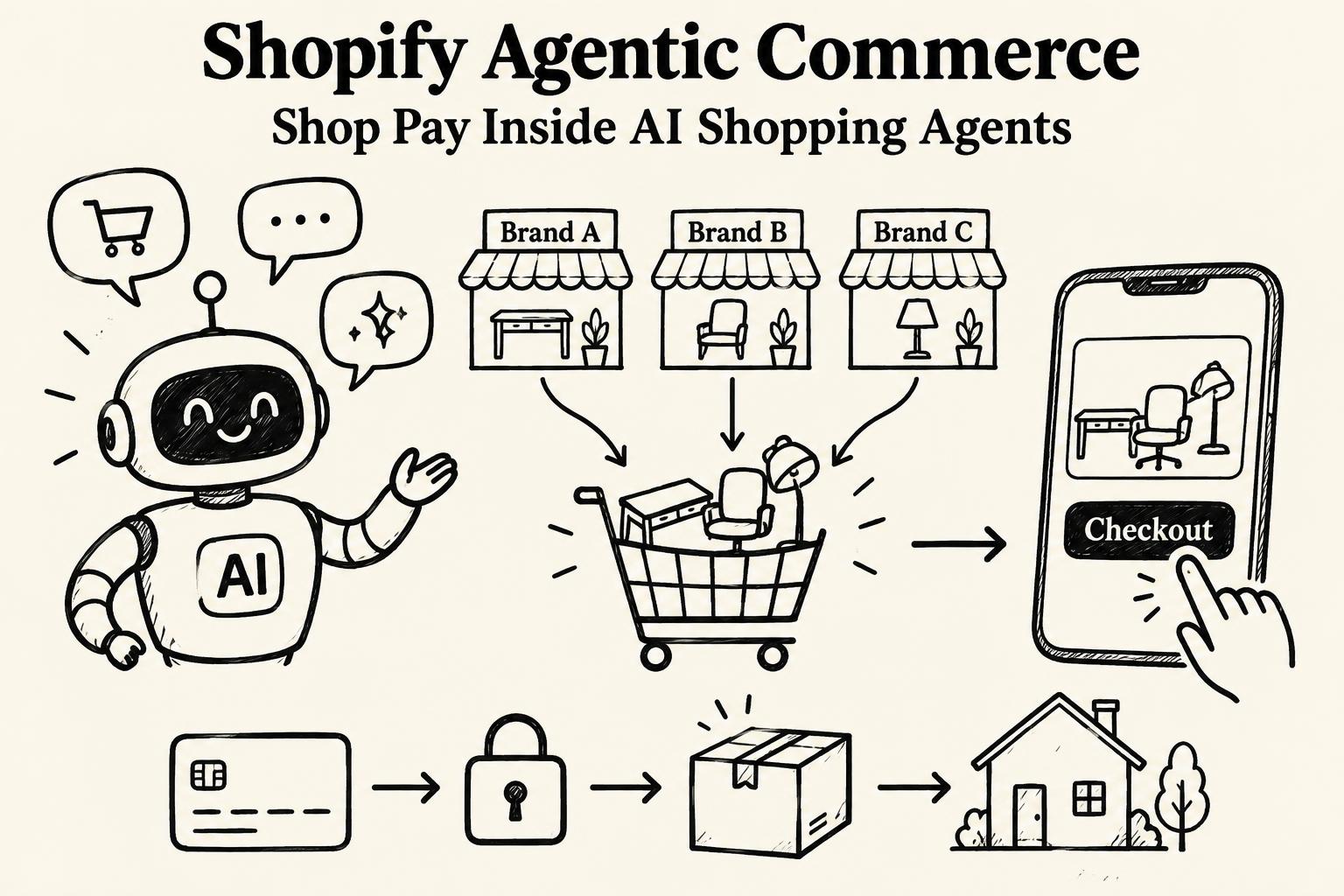
Shopify Agentic Commerce: How Shop Pay Is Bringing Checkout Into AI Shopping Agents
Shopify is taking commerce beyond the storefront. With Shop Pay inside AI agents, Shop.dev, shop.md, and Universal Checkout, customers can discover products and complete purchases in new environments. Here is what the shift means for ecommerce brands.
By Yuvraj Kewate · 2026-11-04
For years, ecommerce brands have invested in getting shoppers to their websites.
They optimized product pages, improved checkout experiences, invested in paid acquisition, and worked to reduce cart abandonment. The objective was straightforward: bring customers to the storefront and convince them to complete a purchase.
That model is beginning to change.
A customer can now ask an AI assistant to find a product, compare alternatives, and help complete a purchase without following the traditional journey from search engine to product page to checkout.
Shopify wants to be the commerce infrastructure behind that experience.
With its Fall '26 Edition, Shopify introduced a broader set of agentic commerce capabilities, including Shop Pay inside personal AI agents, shop.md, Shop.dev, Universal Checkout on Shop, and expanded product discovery through Shopify Catalog.
These announcements represent more than another payment option or AI shopping feature.
They point toward a different distribution model for ecommerce: products are discovered in one environment, evaluated by an AI assistant, and purchased through commerce infrastructure that can operate independently of the merchant's traditional storefront.
For merchants, this raises important questions.
Does your store need to enable Shop Pay? How do AI agents access your product catalog? What happens to checkout customization and payment security? Can customers purchase from multiple brands in one transaction? And how should ecommerce teams measure sales that originate from AI shopping experiences?
Let's examine what Shopify is building and what merchants should do about it.
What Is Shopify Agentic Commerce?
Shopify agentic commerce refers to shopping experiences in which AI agents help customers discover products, evaluate options, and initiate or complete purchases through connected commerce infrastructure.
Instead of requiring customers to navigate every step themselves, an AI assistant can interpret a shopping request, search available products, compare relevant information, and help the customer move toward checkout.
Shopify is building the infrastructure that connects these experiences to its product catalog, customer identity, carts, payments, and order management.
Its Fall '26 announcements include several important components:
- Shopify Catalog: Structured product information made available to supported shopping channels.
- shop.md: A reusable shopping skill that lets compatible AI agents act as personal shoppers.
- Shop.dev: Developer infrastructure for connecting applications and agents to Shopify shopping capabilities.
- Shop Pay in personal AI agents: Enables supported AI shopping experiences to use Shopify's checkout and payment capabilities.
- Universal Checkout on Shop: Allows customers to purchase products from multiple merchants through one Shop checkout experience.
- Agentic storefronts: The merchant-facing controls for managing product discovery and supported AI shopping channels.
These components serve different purposes, but they contribute to the same direction: making Shopify commerce accessible beyond the traditional online store.
For a broader breakdown of the entire release, read our Shopify Editions Fall '26 guide: every major update explained for merchants and app developers.
What Is Shop Pay Inside AI Agents?
Shop Pay is Shopify's accelerated checkout solution. It allows shoppers to use saved checkout information to complete purchases with fewer steps.
Shopify is now extending Shop Pay into supported personal AI agents.
This means customers can use compatible AI shopping experiences to discover products and complete purchases using Shop Pay, without necessarily having to navigate to the merchant's conventional storefront checkout.
Shopify announced support beginning with Meta's Muse, Claude Duet, and Instinct. It also describes Shop Pay availability for purchases from non-Shopify brands through Claude Duet, Grok Bot, and Instinct.
Availability and supported merchant experiences vary by integration.
Shopify says more than 400 million people already trust Shop Pay. Its security model is designed to keep buyers in control of purchases, with payment credentials protected rather than exposed directly to the AI agent.
For merchants, the important change is that Shop Pay is no longer just a checkout convenience associated with Shopify storefronts.
It is becoming part of Shopify's wider commerce distribution infrastructure.
How does an AI agent purchase work?
Consider a shopper looking for a new espresso machine.
They ask their AI assistant:
"I need an espresso machine under $500, preferably with a built-in grinder and good customer reviews. Find three options and help me buy the best one."
A supported shopping experience can follow a journey like this:
- The AI agent interprets the customer's requirements.
- It searches available product information.
- It presents suitable options for comparison.
- The customer chooses a product.
- The agent initiates the supported checkout experience.
- Shop Pay provides the payment experience where supported.
- The customer reviews and authorizes the purchase.
- The merchant processes the resulting order through the supported commerce integration.
The exact interaction depends on the AI platform, merchant eligibility, payment configuration, and integration.
The important point is that the merchant's website does not necessarily have to be the environment where the entire purchase journey takes place.
Why Shopify Wants Shop Pay to Work Beyond Shopify Stores
This is arguably one of the most interesting strategic decisions in the Fall '26 Edition.
Shopify is expanding Shop Pay beyond its traditional association with Shopify merchants.
Through supported AI agent integrations, Shop Pay can also facilitate purchases from brands that do not operate their stores on Shopify.
Why would Shopify do this?
Because controlling the checkout experience can be strategically valuable even when Shopify does not host the merchant's storefront.
Think about the traditional ecommerce relationship.
A merchant controls the storefront, product catalog, customer experience, and checkout. Payment providers compete to process the transaction.
In an AI shopping environment, the customer may never interact with the merchant's website.
The AI platform becomes the discovery and interaction layer. The commerce infrastructure behind the transaction becomes increasingly important.
Shopify is positioning Shop Pay to occupy that role.
This creates several potential advantages.
1. More transactions can flow through Shopify's payment infrastructure
Shopify does not need every merchant to migrate their storefront to participate in every supported agentic commerce experience.
Extending payment capabilities to non-Shopify brands creates a wider potential network of transactions.
2. Customer familiarity can reduce checkout friction
Shop Pay already has an established user base.
For shoppers who have previously used Shop Pay, an agent-assisted purchase can build on familiar payment and checkout behavior.
3. Shopify strengthens its position in the AI commerce ecosystem
AI companies are building shopping experiences, but they still need reliable product information, cart functionality, payment processing, and order workflows.
Shopify has decades of commerce infrastructure and a large merchant network to bring into those experiences.
This creates an opportunity for Shopify to become a transaction layer across multiple AI platforms rather than competing to own just one shopping interface.
Shop.dev and shop.md: The Infrastructure Behind AI Shopping
Shop Pay is only one part of Shopify's agentic commerce strategy.
Two other announcements are particularly important: shop.md and Shop.dev.
Although they are related, they solve different problems.
What is shop.md?
Shop.md is a reusable shopping skill that allows compatible AI agents to act as personal shopping assistants.
Customers can direct an agent to shop.md and use it to search Shopify's catalog of more than one billion products.
With an authorized Shop account connection, supported agents can use relevant customer preferences and shopping history to personalize product recommendations.
The experience can also support checkout and order tracking.
For example, a customer might ask:
"Find a pair of running shoes under $120, in my usual size, suitable for road running."
Instead of manually comparing dozens of product listings, the agent can help narrow the options.
The distinction is important: shop.md is primarily a consumer-facing shopping skill, not a merchant application that needs to be installed in the Shopify admin.
What is Shop.dev?
Shop.dev is Shopify's developer infrastructure for building commerce experiences into applications and AI agents.
It provides access to Shopify shopping capabilities such as:
- Product discovery through Shopify Catalog
- Shop sign-in
- Cart creation and management
- Checkout functionality
- Shop Pay
Developers can use these capabilities to create shopping applications without independently rebuilding every part of the commerce stack.
Shop.dev also gives developers a common foundation for building experiences that work across different AI platforms.
How do they fit together?
| Technology | What it does | Primary audience |
|---|---|---|
| shop.md | Gives compatible AI agents shopping capabilities | Shoppers and agent users |
| Shop.dev | Provides APIs and infrastructure for commerce integrations | Developers and platforms |
| Shop Pay | Handles supported accelerated checkout experiences | Shoppers and merchants |
| Shopify Catalog | Supplies structured product information | Shopping agents and channels |
| Agentic storefronts | Manages merchant participation in supported AI shopping channels | Shopify merchants |
The larger implication is that Shopify is making it easier for developers to build commerce into places where customers already spend time.
For Shopify app developers, this is worth watching closely. The next generation of ecommerce applications may not always be traditional storefront apps or admin extensions. Some will be agent-based shopping experiences built on shared commerce infrastructure. Our newsletter issue on why your Shopify app needs to be ready for AI agents covers this from the founder's side.
Universal Checkout: Why Shopping Across Multiple Brands Could Change
Another important part of Shopify's Fall '26 Edition is Universal Checkout on Shop.
Traditionally, shopping across three different brands means three separate carts and potentially three separate checkout processes.
Universal Checkout allows shoppers to build a cart containing products from multiple merchants and complete one checkout experience in the Shop app.
This changes an important part of the customer experience.
Consider someone shopping for a new home office.
They need:
- A desk from one brand
- An ergonomic chair from another
- A desk lamp from a third merchant
In a traditional shopping journey, the customer visits three websites and completes three separate checkouts.
With Universal Checkout, the customer can bring products from multiple participating merchants into one Shop cart and check out together.
Importantly, the experience still respects merchant-specific checkout extensions and validations.
What does this mean for merchants?
Universal Checkout creates an interesting distribution opportunity.
A customer does not necessarily need to discover every brand independently.
A product from one merchant can become part of a broader shopping mission involving products from other merchants.
However, merchants should also consider the competitive implications.
If shoppers increasingly compare products across brands inside a shared shopping environment, product quality, pricing, availability, reviews, and delivery expectations may become even more important.
Your storefront is no longer the only environment where your brand competes for the sale.
What Happens to Your Existing Checkout Customizations?
This is a practical question that Shopify merchants should not overlook.
Many brands have invested heavily in their checkout experience.
They use custom checkout extensions, upsells, delivery options, gift messages, loyalty integrations, shipping rules, and payment customizations.
What happens when a customer purchases through an AI agent instead of the traditional online store?
The answer depends on the particular integration and supported checkout capabilities.
Shopify's Universal Checkout announcement specifically states that it respects each merchant's checkout extensions and validations.
However, merchants should not assume that every custom storefront feature will automatically appear in every external agent experience.
Before relying on agentic checkout, review:
- Product and variant availability: Can the agent initiate a purchase for the correct product configuration?
- Pricing and discounts: Are the applicable prices and promotions reflected correctly?
- Shipping and delivery: Are the supported delivery options and restrictions respected?
- Checkout validation: Do your required validations continue to work in the supported flow?
- Upsells and cross-sells: Are your existing promotional experiences supported, or do they depend on the traditional storefront?
- Loyalty and rewards: Can customers use their existing benefits in the relevant checkout experience?
- Order processing: Are orders correctly recorded and handled by your fulfillment systems?
The objective is not to assume that agentic checkout will replace your existing checkout immediately.
It is to understand which parts of your existing commerce experience carry over and which may need a different implementation.
How Does Agentic Commerce Affect Product Discovery?
There is a tendency to discuss agentic commerce primarily as a checkout innovation.
But checkout is only the final part of the shopping journey.
Before an AI agent can help a customer purchase a product, it needs to find and understand that product.
This is where Shopify Catalog becomes important.
Shopify Catalog makes eligible product information available to supported shopping channels in a structured format.
The information can include:
- Product titles and descriptions
- Product images
- Variant options
- Pricing and compare-at prices
- Availability
- Relevant product attributes
Shopify continuously updates catalog information so supported AI channels can access current product information.
Merchants can review their eligibility and product data mapping under Sales channels → Agentic.
One important distinction: Shopify Catalog is not the only way products can be discovered. Depending on the AI channel, products may also be accessed through web crawling, indexing, and other product feeds.
Therefore, catalog eligibility is an important distribution check, not a guarantee of inclusion in every AI recommendation.
Product data is becoming a competitive advantage
Imagine two brands selling office chairs.
The first product description says:
"Premium ergonomic chair designed for modern workspaces."
The second says:
"Ergonomic office chair with adjustable lumbar support, breathable mesh back, height-adjustable armrests, a 120 kg weight capacity, and a reclining mechanism."
If a shopper asks an AI agent to find an ergonomic chair with adjustable lumbar support and a weight capacity above 100 kg, the second description provides much clearer matching information.
This does not guarantee recommendation placement, but it makes the product easier to evaluate.
Merchants should pay particular attention to structured product attributes, metafields, variant grouping, and channel-specific product data mapping.
What Merchants Should Do Before Relying on AI Agent Checkout
Agentic commerce is still developing, and availability varies across integrations and markets.
Merchants should avoid treating it as an immediate replacement for their existing acquisition and checkout channels.
Instead, use the following readiness framework.
1. Review your Agentic storefront settings
Open Sales channels → Agentic in Shopify admin.
Review:
- Which AI shopping channels are available
- Whether your products are eligible for Shopify Catalog
- Whether direct checkout is supported for each channel
- Whether your store is enrolled in the available experiences
- Whether your product data mapping needs attention
Shopify's default managed setting can automatically enroll eligible stores in supported future agentic storefronts. Merchants who prefer individual control can manage their channel settings manually.
2. Confirm Shop Pay and payment readiness
Review your payment configuration and determine which supported agentic checkout experiences are available to your store.
Do not assume that enabling Shop Pay automatically makes every AI checkout experience available.
Eligibility can depend on the merchant, customer location, payment setup, and AI channel.
3. Audit your product catalog
Prioritize your best-selling products and important BFCM collections. If you are also preparing other channels for the season, see our Shopify WhatsApp automations BFCM 2026 setup guide.
Check:
- Complete product titles and descriptions
- Accurate prices and compare-at prices
- Correct variants and product identifiers
- High-quality product images
- Inventory accuracy
- Relevant specifications and metafields
Make sure custom product information is correctly mapped for Shopify Catalog where necessary.
4. Publish accurate business information
Shopify's Agentic section includes a Knowledge Base where merchants can review and publish non-product information about their business.
This can include:
- Shipping destinations
- Delivery timelines
- Return windows
- Refund policies
- Gift services
- Brand information
AI agents need accurate information to answer customer questions.
If your store offers different return windows for different product categories, ensure that the information is clearly represented and does not create misleading expectations.
5. Test the purchase journey
Do not stop at checking whether your products appear in AI search results.
Test the entire journey wherever the channel is available:
- Search for a product using a realistic customer request.
- Review the product information returned.
- Select the appropriate variant.
- Initiate the supported cart or checkout experience.
- Review pricing and shipping information.
- Confirm the payment and customer authorization flow.
- Verify that the resulting order appears correctly in your Shopify admin.
This helps identify issues that would otherwise remain hidden until a real customer attempts to purchase.
6. Review fraud and fulfillment processes
A purchase originating from an AI assistant still needs to be fulfilled correctly.
Review fraud screening, inventory synchronization, shipping rules, customer notifications, returns, and post-purchase support.
Shopify's broader Fall '26 updates also include improvements to Shopify Protect and payment risk management.
These capabilities deserve attention as merchants prepare for higher transaction volumes, but they should not be treated as a substitute for reviewing your own fraud and fulfillment processes.
How Should Ecommerce Brands Measure Agentic Commerce?
This is where many merchants will need to develop new reporting habits.
Traditional ecommerce reporting is organized around channels such as paid search, organic search, email, social, affiliates, and direct traffic.
Agentic commerce introduces another source of product discovery and transactions.
Merchants need to understand not only how many orders originate from AI shopping experiences, but also whether those orders generate additional business.
Start by monitoring the following metrics.
| Metric | What it tells you |
|---|---|
| Agentic-attributed sessions | Traffic associated with supported AI shopping channels |
| Agentic-attributed orders | Purchases attributed to agentic storefronts |
| Agentic-attributed revenue | Revenue associated with those orders |
| Average order value | Value of orders from agentic channels |
| Conversion rate | How effectively agentic traffic converts |
| New customer acquisition | Whether the channel introduces new customers |
| Repeat purchase rate | Whether acquired customers return |
| Return and cancellation rate | Quality of purchases generated through the channel |
Don't confuse attributed revenue with incremental revenue
Suppose an AI agent recommends your product to a shopper who has already purchased from your brand several times.
The shopper completes a purchase through the agent.
The order may be attributed to that AI channel, but that does not prove the sale would not have happened through another channel.
This distinction matters when evaluating acquisition costs and allocating marketing budgets.
Merchants should compare agentic performance against existing acquisition channels, monitor new customer behavior, and use controlled experiments where possible.
The objective should be profitable incremental growth, not simply increasing the number of channels receiving attribution.
What Does Agentic Commerce Mean for Shopify App Developers?
Although most discussions focus on merchants, this shift also has implications for the Shopify app ecosystem.
Shopify is expanding the infrastructure available to developers through Shop.dev, Catalog, cart, and checkout capabilities.
That creates new opportunities for developers building applications around AI-assisted shopping.
Consider the potential areas of development:
- AI shopping assistants: Specialized agents that help shoppers discover products within specific categories.
- Product data enrichment: Applications that improve product attributes, descriptions, and catalog quality.
- Agentic merchandising: Tools that organize products for different shopping intents and customer requirements.
- Commerce analytics: Applications that measure discovery, conversion, and performance across AI shopping channels.
- Post-purchase experiences: Applications that improve order tracking, returns, customer communication, and retention after agent-assisted purchases.
There is also a strategic challenge.
As Shopify expands native commerce capabilities, developers need to understand where their products add value beyond the infrastructure Shopify already provides.
An application that only replicates basic product search may face pressure as native agentic discovery becomes more capable.
The stronger opportunities may sit in specialized workflows, advanced merchandising, vertical-specific experiences, integrations, and measurable outcomes.
For app founders, the question is no longer just whether merchants need another app.
It is whether that app solves a problem that becomes more important as commerce moves into AI-powered environments.
The Bigger Picture: Shopify Is Competing to Become the Commerce Layer Behind AI
The most important takeaway from Shopify's Fall '26 Edition is not any individual feature.
It is the direction of the platform.
Shopify is connecting product discovery, customer identity, shopping preferences, checkout, payment processing, and order management to experiences that exist outside traditional storefronts.
AI platforms are competing to become the interface customers use to search, compare, and make decisions.
Shopify is positioning itself to power the commerce transaction behind those interfaces.
This is a meaningful distinction.
The company does not necessarily need to own the AI assistant to participate in the transaction.
It needs to provide infrastructure that developers and platforms can use to connect shopping intent with products and purchases.
For merchants, the implications are equally important.
Your website will remain a critical part of your business. But it may no longer be the only place where customers discover your products, compare alternatives, or complete purchases.
The brands that prepare for this shift will have more opportunities to participate in emerging shopping experiences without abandoning the channels that already generate revenue.
Frequently Asked Questions
What is Shopify agentic commerce?
Shopify agentic commerce allows AI agents to help shoppers discover products, compare options, and complete purchases through supported commerce integrations. Shopify provides the catalog, identity, cart, checkout, and payment infrastructure behind these experiences.
What is Shop Pay in AI agents?
Shop Pay in AI agents allows customers to use Shopify's accelerated checkout capabilities within supported AI shopping experiences. It enables purchases without requiring every transaction to begin and end on a merchant's traditional storefront.
Which AI agents support Shop Pay?
Shopify announced Shop Pay checkout inside Meta's Muse, Claude Duet, and Instinct. Claude Duet, Grok Bot, and Instinct also support Shop Pay for purchases from non-Shopify brands. Availability and supported capabilities vary by integration.
Do Shopify merchants need Shop Pay to participate in agentic commerce?
Shop Pay is an important part of Shopify's agentic checkout infrastructure, but merchants should review individual channel requirements rather than assume it is universally mandatory. Product discovery and direct checkout have different eligibility requirements.
What is the difference between shop.md and Shop.dev?
Shop.md is a reusable shopping skill for compatible AI agents. Shop.dev is the developer infrastructure that provides access to Shopify Catalog, Shop sign-in, carts, checkout, and Shop Pay.
What is Universal Checkout on Shop?
Universal Checkout lets shoppers purchase products from multiple participating merchants through a single checkout experience in the Shop app. It is designed to simplify shopping across brands while respecting merchant-specific checkout extensions and validations.
Does Shopify agentic commerce work for non-Shopify merchants?
Yes. Shopify has expanded certain Shop Pay experiences to purchases from non-Shopify brands through supported AI agents. Shopify also offers an Agentic plan for businesses that want to sell through Shopify's agentic storefront infrastructure without migrating their existing ecommerce platform.
How can Shopify merchants enable agentic storefronts?
Merchants can review their settings under Sales channels → Agentic in Shopify admin. They can check channel availability, Catalog eligibility, product data mapping, and supported checkout settings.
Will AI agents replace traditional ecommerce websites?
Not necessarily. AI agents introduce additional discovery and purchasing interfaces, but traditional websites remain important for brand storytelling, customer education, merchandising, content, and direct customer relationships. The likely direction is a combination of storefront and agent-based shopping experiences.
How can Shopify brands track AI-driven sales?
Merchants can use Shopify's agentic storefront performance reporting to monitor available sessions, referrals, and sales. They should also evaluate new customer acquisition, conversion, repeat purchases, and incremental profitability.
Final Thoughts: The Next Ecommerce Checkout May Not Happen on Your Website
Shopify's investment in agentic commerce is a clear signal that the traditional storefront is no longer the only environment where ecommerce transactions will happen.
Shop Pay inside AI agents, Shop.dev, shop.md, and Universal Checkout are building blocks for a shopping ecosystem where customers can discover and purchase products across multiple interfaces.
For merchants, this is not a reason to abandon existing marketing investments or rebuild their stores around AI.
It is a reason to prepare their commerce infrastructure.
Make product information accurate. Review agentic storefront eligibility. Understand how supported checkout experiences work. Keep payment, inventory, shipping, and returns information current. And establish a way to measure the business impact of AI-driven transactions.
For Shopify app developers, the opportunity is to build products that solve the new problems emerging around agentic shopping rather than simply duplicating platform capabilities.
The storefront is not disappearing.
But the next customer who buys from your brand may not visit it first.
Keep up with Shopify's changing commerce ecosystem with SaaSOri, your independent source for Shopify platform updates, app discovery, and ecommerce technology analysis.
Shopify Agentic Commerce: How Shop Pay Is Bringing Checkout Into AI Shopping Agents