
Best Legal Answering Service: 7 Providers for Law Firms
Compare the best legal answering service providers for law firms in 2026 — pricing, intake, coverage, integrations, and how to choose the right fit.
By Yuvraj Kewate · 2026-11-17
At 9:40 on a Tuesday night, someone who slipped on a wet floor at a grocery store sits at her kitchen table with a phone and a notepad. She calls three firms in a row. The first rings out to a voicemail box that's full. The second answers with a generic greeting, takes her name, and promises a callback. The third picks up, asks whether she's seen a doctor, confirms the state where the fall happened, notes the property owner's name, and books her for a consultation the next morning. She signs with the third firm.
That's the entire competition. Not the website, not the billboard, not the review count. Whoever answers, and answers with a real intake conversation, wins the matter.
A legal answering service earns its fee on six things: how calls get handled, whether the caller's details land in usable form, the hours you're covered, the integrations that push intake into your practice management system, the billing model, and the security and supervision rules around what a non-lawyer or an AI is permitted to ask. This roundup compares eight providers on those dimensions, with particular attention to two factors that decide both cost and fit. How each one bills, and whether its trial lets you rehearse your own scripts before you commit.
Table of Contents
- 1. Lighthouse Legal
- 2. Answering Legal
- 3. Alert Communications
- 4. LEX Reception
- 5. Smith.ai
- 6. Ruby
- 7. PATLive
- 8. Posh
- Legal answering service providers compared
- Choose by Billing Model, Then Test With Real Calls
1. Lighthouse Legal
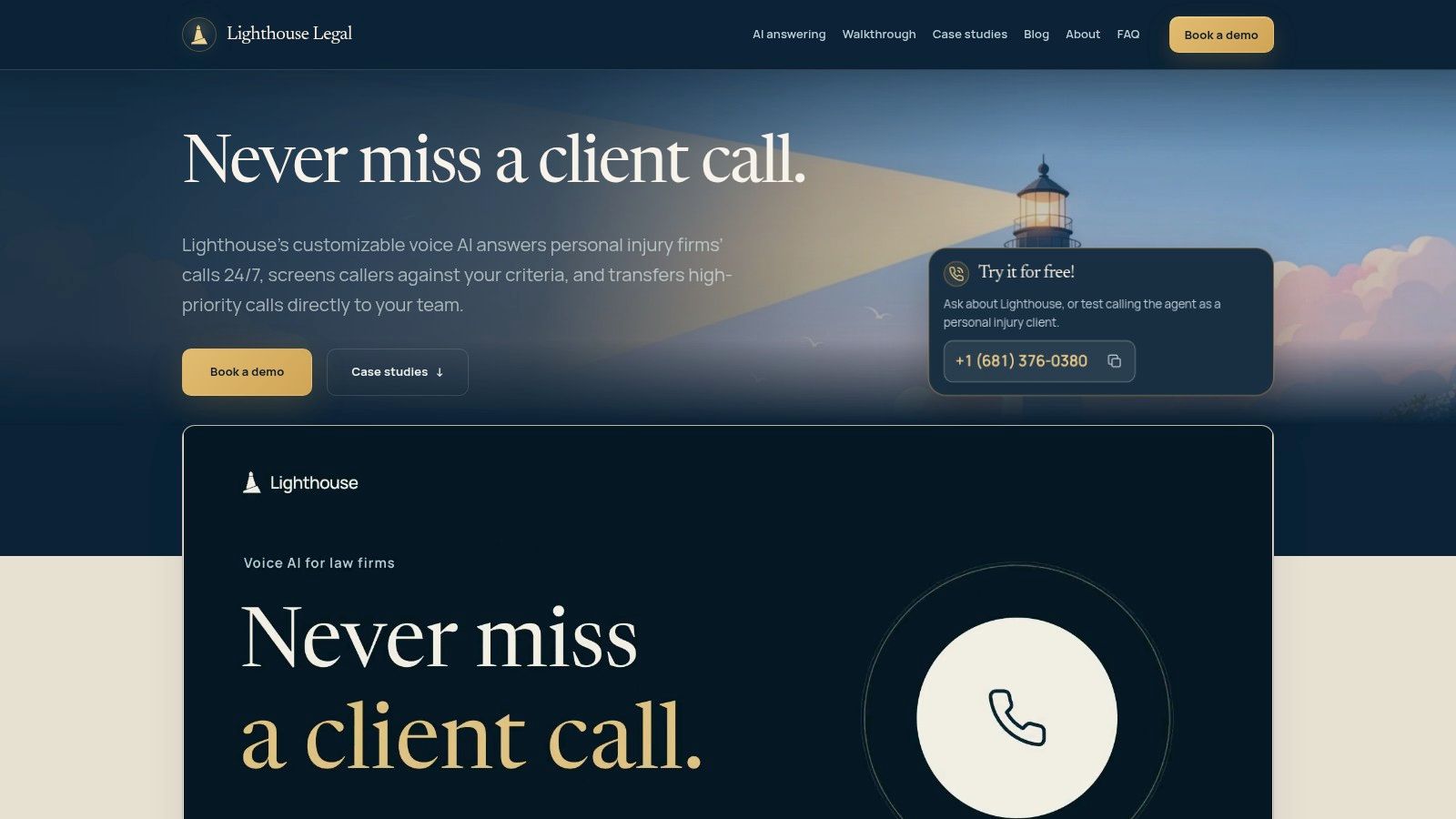
Lighthouse Legal builds configurable AI voice agents for personal injury firms. It's an AI answering service for law firms that answers incoming calls, runs through screening questions the firm defines, and routes qualified callers to attorneys or intake staff. Lighthouse Legal Labs, Inc. operates it, and the product is designed to supplement an existing team rather than replace it.
How the flat monthly rate changes the math
Pricing is a flat monthly rate set by call volume, with no per-minute metering and no long-term contract. That structure matters in personal injury, where intake calls run long. A caller describing a multi-vehicle collision with two surgeries and an open workers' compensation question will not be screened in ninety seconds. On a metered plan, your best leads are your most expensive calls. On a flat rate, they aren't.
The trade-off runs the other way. You're buying a call volume band, so you need an honest estimate of monthly inbound volume before signing, including the spike after a television buy or a paid search push. Ask what happens when a mass tort campaign doubles your volume in a week.
Where the intake work actually happens
- Screening against your criteria. The agent follows firm-defined questions, collects the facts that matter, and flags inquiries warranting a lawyer's attention.
- Live transfers. Qualified or high-priority callers go straight to the firm, and the agent hands off to a person whenever the caller asks for one.
- A record of every call. Each call produces a recording, transcript, and report, and the firm retains ownership of its call data.
- Fast deployment. Implementation starts with a review of your screening and routing workflow, then either a new Lighthouse number or forwarding on an existing line.
Judge an AI intake tool the way you'd judge a paralegal hire: signed cases attributable to calls it handled, the share of callers it correctly screened out as irrelevant, and whether the intake details hold up when a lawyer reads the transcript. Those are the numbers to pull during any trial period, whatever the vendor's own case studies claim.
The question worth asking any AI intake vendor: which fields does the agent collect before a conflict check runs, where do transcripts live, and how does deletion work on request?
That question isn't theoretical. Someone who calls about a possible representation can be a prospective client under ABA Model Rule 1.18 and Formal Opinion 506, even when the firm never takes the matter, and the same guide notes that ABA client-intake coverage warns against letting AI make client-related decisions without adequate attorney supervision. A deliberately limited intake, name, opposing party, matter type, often reduces ethical exposure better than an impressive conversational script.
When Lighthouse is the wrong call
If your practice is a general civil mix with heavy existing-client traffic, an AI agent tuned for personal injury intake solves a problem you don't have. Firms that need a human voice on every first call, or that have nobody available to receive a warm transfer during business hours, should look at the live services below. And if you can't staff the follow-up, routing more qualified callers into an empty inbox changes nothing.
2. Answering Legal
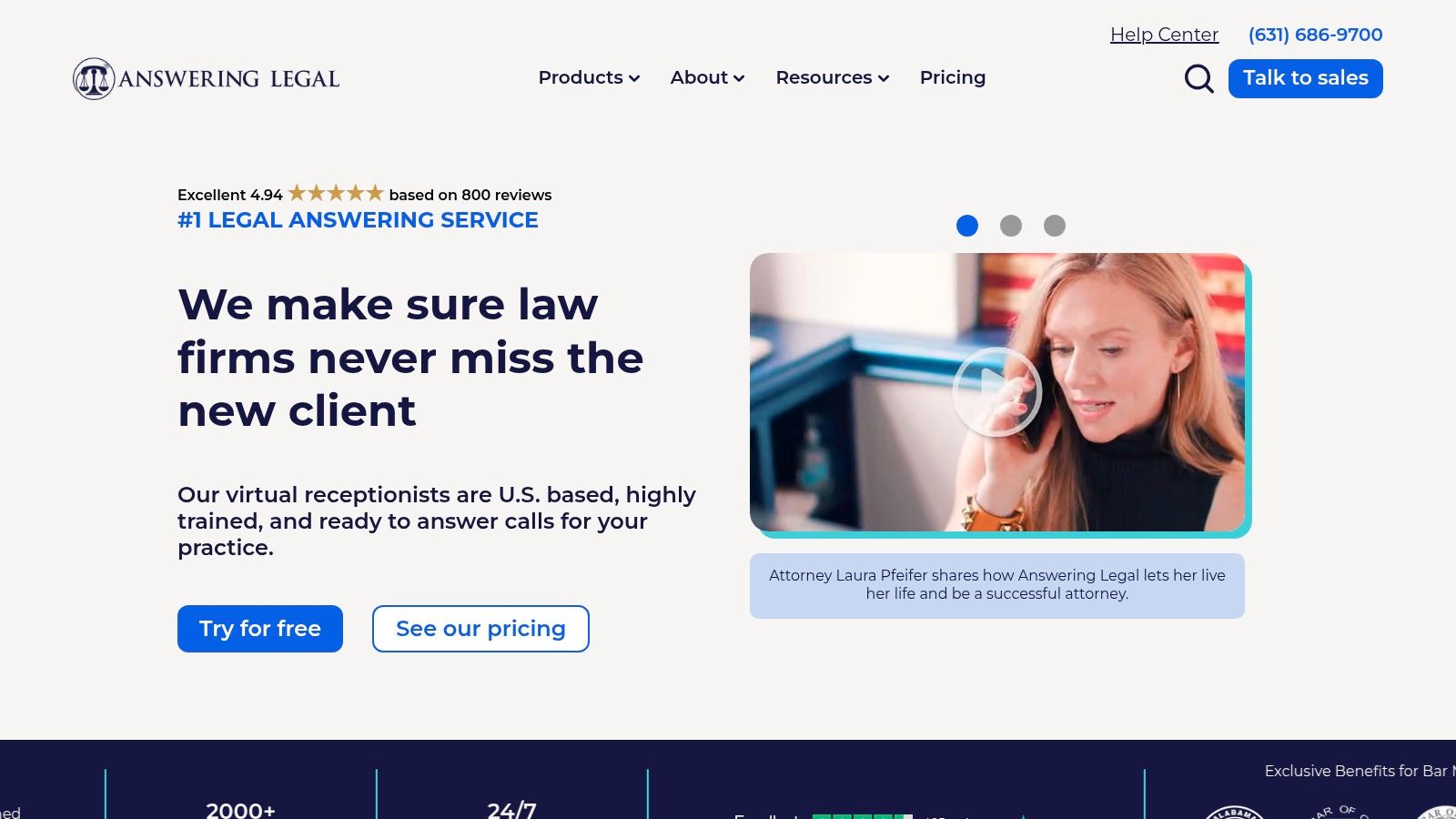
Answering Legal is the traditional model done well: legal-only, human receptionists, minute-based billing, quoted rather than published. There is no public plan table, so the trial period is where you learn what the service will cost your firm. Get the quote in writing, and confirm how overage minutes and after-hours calls are billed before you compare it against a per-call provider.
What the trial and billing look like
Coverage is 24/7/365 live answering, weekends and holidays included, with U.S.-based receptionists working from custom intake scripts. They screen prospective clients, schedule appointments, transfer calls, and deliver messages. Integrations cover Clio Grow, MyCase, Lawmatics, and PracticePanther, and English-Spanish answering is available. The company offers a free trial and month-to-month service.
Use the trial on your real script, not the demo one. Send the service the same intake questions your paralegals ask, then listen to how receptionists handle a caller who rambles, a caller who is angry, and a caller who is already represented. Minute-based billing suits short screening calls and punishes long consults. If your average intake call runs four minutes, a minute plan beats a per-call plan every month. If half your calls are fifteen-minute collision narratives, the math flips.
The value shows up in staff time rather than lead volume. In figures MyCase published on law firm answering services, 33% of firms reported gaining one to two leads per week through virtual receptionist services, while 43% reported saving one to five hours per month. That is the honest version of the pitch: coverage buys back an afternoon.
Where it strains: the legal-only focus means no broader business answering, and quote-based pricing is harder to budget than a published tier. Firms still settling their entity structure before they shop for intake can work through that first step with this guide to the best LLC formation services.
3. Alert Communications
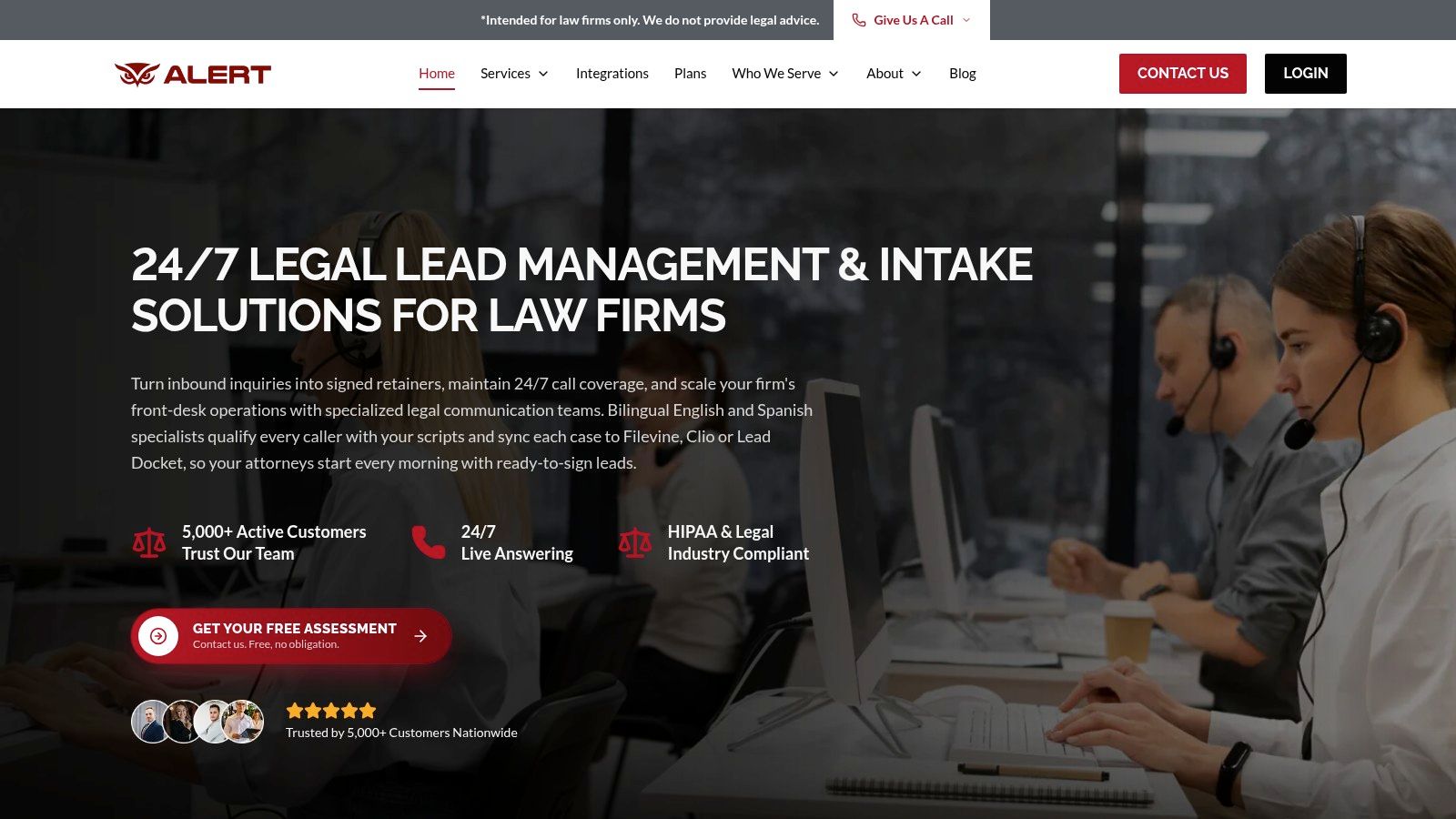
Alert Communications is the easiest provider here to price against your own call log because it publishes a tier ladder instead of forcing every prospect into a quote. Basic covers 24/7 legal call answering and message delivery. Advanced adds new-client intake and lead follow-up. Premier builds retainer-related workflows on top and introduces a per-retainer charge when a caller becomes a signed client.
Reading the tier table before you call
That ladder maps to three jobs rather than three feature bundles. Choose Basic when the goal is coverage and clean messages. Choose Advanced when the intake team needs to qualify prospects and chase follow-ups before they cool. Premier only makes sense if signed retainers are a visible, counted outcome in your reporting; otherwise an outcome-based fee turns into a surprise line item.
This is the one structure on the list where part of the cost can track conversion rather than talk time. Run the math before the sales call. If a steady share of callers signs through the service, the retainer component is a known cost of acquisition. If conversion is rare or impossible to attribute, the top tier will look efficient on paper and expensive in practice.
The company also lists a secure client portal and HIPAA-compliant service, relevant for firms whose callers discuss treatment details in injury or workers' compensation matters. Ask how overages, setup fees, and add-ons are billed before comparing the ladder to a per-minute rival.
Why tiered intake sells at all: a North Carolina Bar Association summary of Clio's secret-shopper research found that among calls routed to voicemail, 57% were not returned within 72 hours, and only 29% of firms gave a timely, informative response that addressed a question and offered consultation or pricing information.
Pay-as-you-go is the pressure valve: useful for campaign spikes, seasonal surges, or a firm testing whether inbound volume justifies a monthly commitment. Predictable volume belongs on a plan.
4. LEX Reception
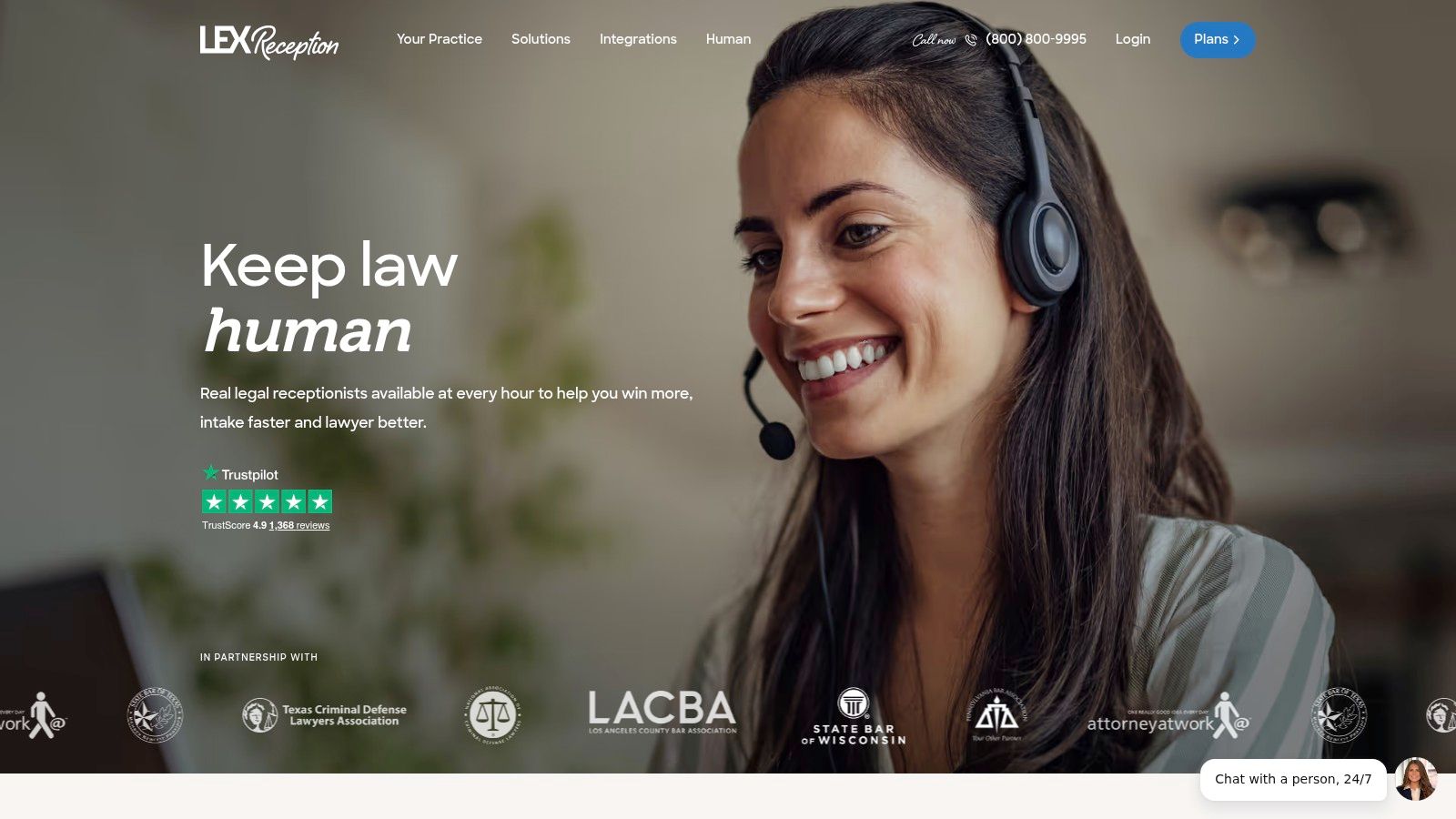
A free trial of 150 minutes across 30 days is the strongest reason to shortlist LEX Reception. You cannot judge an intake script by reading it. You judge it by calling your own number at 11 p.m. and hearing how a stranger handles a question your script never anticipated.
Testing scripts inside 150 free minutes
Plans start at $425, so confirm included minutes, overage rates, and current terms before signing. Minute-based billing rounds call time up to the next minute, which stays invisible on a long consult and becomes expensive on a run of 40-second wrong numbers.
Use the trial on the calls that usually break intake, not the easy ones:
- Your actual opening question. Does the receptionist ask about the injury date before or after the caller's name? Order changes how much you learn.
- A deliberately awkward call. Have someone say they are already represented and see whether the receptionist catches it.
- The handoff. Ask for a transfer mid-sentence and time how long the caller waits.
- The written record. Read the transcript as if you were the associate picking it up an hour later with no context. If intake feeds drafting or fee work, our guide to AI contract review covers the next tool in that chain.
Beyond the trial, the service provides live human answering and legal intake, appointment scheduling with scheduling-software support, bilingual answering, call recordings and call data, and legal-software integrations. Plans can be changed as usage shifts, which helps firms whose call volume moves with campaigns, referrals, or seasonal practice areas.
Speed is where the trial earns its keep. The 2024 Legal Consumer Report from Martindale-Avvo found 85% of consumers expect a response within 48 hours or less, while 40% will contact another attorney in under 24 hours; the same survey found email is increasingly preferred for first contact, followed by phone and live chat with a human representative rather than a chatbot.
The limits are real. Minute-based billing gets unpredictable when volume swings, and 150 trial minutes tell you little about the monthly bill once intake, scheduling, transfers, and after-hours calls all count. Ask for the complete price sheet in writing, then test the exact script your firm would pay for.
5. Smith.ai
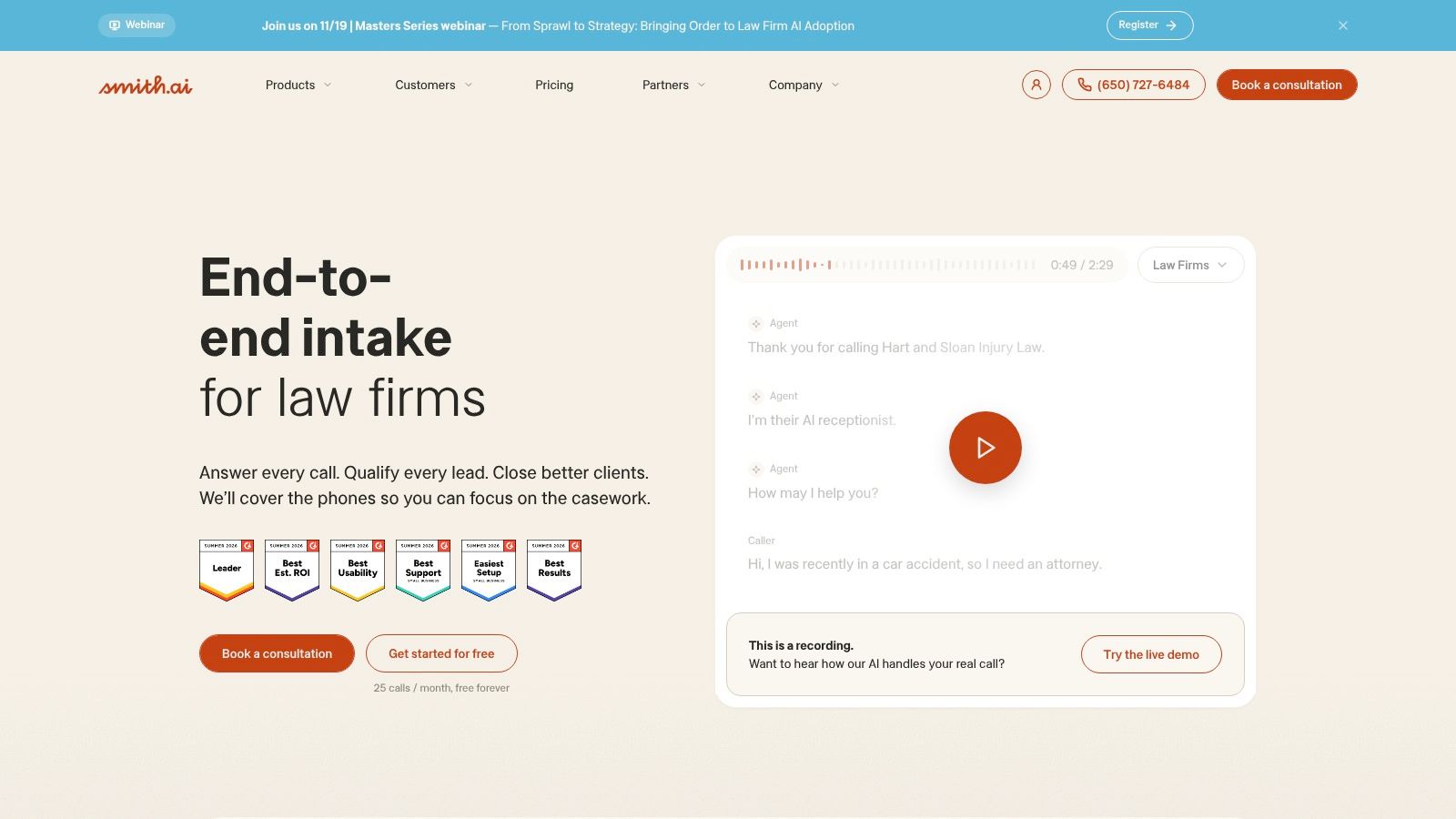
Smith.ai is the clearest example of per-call billing on this list. Its live receptionist plans are sold as bundles of answered calls, with minutes off the meter, so the monthly fee only makes sense after you divide it by the number of calls you expect.
The per-call math that decides fit
Call length stops being the cost driver. A fifteen-minute consult and a wrong number can consume the same unit, which rewards firms with real conversations and punishes firms whose phones ring often for tiny reasons. If your average call is short, predictability may cost more than volatility.
Before signing, ask for the plan sheet in writing and have the salesperson mark which workflows add a separate per-call charge, plus how an exhausted bundle is billed. Appointment booking and conflict checks are the two line items to ask about directly, because the gap between the advertised bundle and the monthly invoice usually hides in intake extras.
What you are buying is configurability. Live-staffed answering runs around the clock with lead screening, qualification and intake workflows, CRM integrations including Clio, appointment booking and call transfers. Separate AI and hybrid products let a firm keep the same account while testing whether routine calls can be automated.
Response expectations still justify coverage. Clio's consumer research, compiled in this collection of law firm call statistics, found 79% of legal consumers expected a response within 24 hours of contacting a firm, including 10% wanting an answer within one hour, 24% within a few hours, and 45% within 24 hours. The same research found 64% of consumers had contacted a firm by phone or email and never received a response.
For firms weighing staffed answering against automation, this guide to the best AI receptionist options is the right comparison before assuming every call needs a human. I would shortlist Smith.ai when calls are long and valuable; I would skip it when volume is low and the phone mostly produces quick administrative messages.
6. Ruby
Ruby is the provider on this list that isn't a legal specialist, and it doesn't pretend to be. What it sells is a human receptionist with a custom greeting, lead-detail capture, call transfers, and appointment scheduling, available as full-time coverage or overflow. Plans are minute-based, so pull Ruby's current rates before you shortlist it, and confirm what the entry plan's included minutes buy.
Where a general receptionist starts to strain
Entry plans on minute-based services typically cover a small block of minutes, enough for a dozen short calls a month. Past that, overages on a general service get expensive quickly, and you're paying legal-adjacent rates for intake depth that may not match a legal-only provider.
The honest use case is a small firm that needs a warm human voice and a clean message rather than a full intake engine. Ruby handles the personal-caller experience well and adds live chat as a second channel. Verify three things before signing: whether its intake workflows capture the fields your conflict check needs, whether it integrates with your practice management system, and whether bilingual screening is available if your caller base requires it. A beautiful call experience that ends in a free-text email to your paralegal is still manual work.
The market context explains why phone coverage still matters in an email-first world. Clio's 2024 Legal Trends Report coverage, summarized by the Illinois Supreme Court Commission on Professionalism, found that 33% of law firms responded to secret-shopper emails, against 40% that answered phone calls. Neither number flatters the profession. A firm that fixes both channels beats most of its local competition without spending a dollar on advertising.
Where Ruby is right: solo and small practices where the first impression is the product, and firms that want one vendor for voice and chat. Where it's wrong: high-volume personal injury intake, where script depth and call volume punish a generalist's minute plan.
7. PATLive
PATLive publishes its rates openly and sells plans on month-to-month terms with no long-term contract, an unusual combination in a category where many providers quote pricing only after a sales call. A 14-day free trial lets a firm run live calls through the service before committing a dollar.
A 14-day trial with published rates
Two weeks is enough for a real test if you plan it. Route every inbound call to the service for the full period, including the calls your paralegal would normally grab. Then read the transcripts. You're checking whether the receptionist asked what you'd have asked, and whether the written summary let someone return the call without dialing the prospect twice.
Billing is the familiar trade-off. Per-minute plans reward short calls and punish long intake conversations, so build your cost estimate from your own call log rather than the tier name. Legal is one vertical among several here, which means intake depth depends on the script you build and test during the trial window.
Size the gap before you buy anything. The American Bar Association's coverage of Clio's 2024 Legal Trends Report reported that among 500 law firms contacted by secret shoppers, only 40% answered the initial phone call. That number is what the trial should prove against: every call answered, every time, including the ones that arrive at 6 pm on a Friday.
A small firm buying phone coverage for the first time gets the most from PATLive, since published rates make the math predictable and the contract carries no lock-in. A firm that needs practice-area-specific screening on complex matters from day one should look higher on this list.
8. Posh

Posh lets a firm choose live virtual receptionists, AI, or a combination on the same account, making it the most flexible option in this roundup. Plans are organized as monthly minute-based tiers, starting from entry levels with no included minutes and scaling up to larger bundled-minute packages, with per-minute charges once you exceed the bundle. Check the current pricing page before you budget, because the gap between a no-minutes tier and a bundled one is where the main cost decision lies.
Live, AI, or both
The hybrid option suits firms that want a human on new-client calls and automation on after-hours or existing-client traffic. Receptionists follow custom intake procedures, schedule appointments, transfer calls, and deliver messages through the app, text, or email. Integrations include Rocket Matter, Calendly, Acuity, and Zapier, and the company lists no setup or cancellation fees.
The risk is the same one minute-based billing always carries. Total cost tracks call length and volume, and an entry tier with no included minutes is a starting point, not a budget. Build the estimate from your own call log: pull a month of calls, count the minutes, and price the tier you'd land in rather than the one with the lowest sticker.
Then test the AI on the calls you'd least want it handling. Give it a caller who is upset, a caller who is already represented, and a caller who wants to know whether they have a case at all. Watch whether it escalates to a person without being asked twice.
That last point is the one buyers skip. The best legal answering service collects only what it should before a conflict check, hands off cleanly, and leaves a record your team can act on. Every provider here can do that with a good script. None of them will do it with a bad one.
Legal answering service providers compared
Read the table left to right: billing model predicts how cost behaves, starting price marks the entry point rather than the likely bill, and the trial column shows whether you can run real intake scripts before signing.
| Provider | Pricing model | Starting price | Free trial / test | Best for |
|---|---|---|---|---|
| Lighthouse Legal | Flat monthly fee based on call volume | Custom quote | Custom quote after a screening workflow review | Personal injury firms seeking AI-powered intake and 24/7 coverage |
| Answering Legal | Custom plans; minute-based billing | $198 per month | Free trial available | Law firms wanting live legal intake, bilingual answering, and software integrations |
| Alert Communications | Monthly tiers or pay-as-you-go at $2.50 per minute; some plans charge per retainer | $240 per month (Basic, 100 minutes) | No free trial listed; request a quote | Firms seeking options from basic answering to intake and retainer support |
| LEX Reception | Plans with minute-based billing | $425 | 150 minutes for 30 days | Firms wanting to test live legal intake and receptionist workflows |
| Smith.ai | Per-call plans with overage charges | $300 per month for 30 calls | No free trial listed; request a quote | Firms needing configurable live intake with per-call pricing |
| Ruby | Monthly minute-based plans | $245 per month for 50 minutes | No free trial listed; request a quote | Firms wanting human answering, overflow coverage, and live chat |
| PATLive | Pay-as-you-go or monthly minute-based plans | $49 per month | 14-day free trial | Firms seeking flexible 24/7 live answering with public pricing |
| Posh | Monthly minute-based tiers; live, AI, or hybrid options | $65 per month | No free trial listed; request a quote | Firms comparing human, AI, and hybrid legal call handling |
Choose by Billing Model, Then Test With Real Calls
Start with the billing model, because it determines which calls you can afford to want. Per-call pricing suits firms whose value sits in long consultations: personal injury intake, family law, criminal defense, anywhere a single conversation runs fifteen minutes and ends with a scheduled meeting. Call length stops mattering, so you stop rationing.
Per-minute pricing suits firms whose calls are short and whose volume is predictable. Document review practices, collections work, high-volume tenant screening. It also suits firms that want to start small and scale, since minute plans flex with usage. The trap is estimating volume from your best month and budgeting from it.
Flat monthly pricing by volume band, the Lighthouse model, suits firms with uneven intake where one call can be worth a year of fees. Pay-as-you-go fits campaign testing, seasonal practices, and any firm that does not know its inbound volume yet.
A pre-signature checklist
- Map the integration first. Confirm the provider writes to your practice management system, not to a shared inbox your paralegal retypes from.
- Send your own script through the trial. Test a scripted call, an unscripted one, and one designed to trip the screening logic.
- Read three transcripts cold. If you can't act on the note without calling the person back, the intake is incomplete.
- Time the escalation. A caller with an arrest, a filing deadline, or a hospital discharge needs a person within minutes, not a callback tomorrow.
- Ask what's excluded. Transfers, after-hours minutes, appointment booking, Spanish-language calls, and conflict-check workflows are the usual add-ons.
- Sign month-to-month where you can. A trial you've already run is the only reference check worth trusting.
One more piece of diligence that rarely makes the sales deck: ask where call recordings and transcripts are stored, which subcontractors touch them, whether your data trains anyone's model, and how deletion works. Those answers belong next to the price.
Firms that need a broader technology shortlist, from intake automation to the software sitting behind it, can browse the curated comparisons and research published on The SaaS Hub. Our team evaluates tools on performance and reliability, support quality, value for money, and integration quality, and we publish the findings rather than the marketing copy. If you're weighing the best legal answering service for your firm this quarter, pick two finalists whose billing models match your call profile, run both trials with your own scripts, and let the transcripts make the decision.