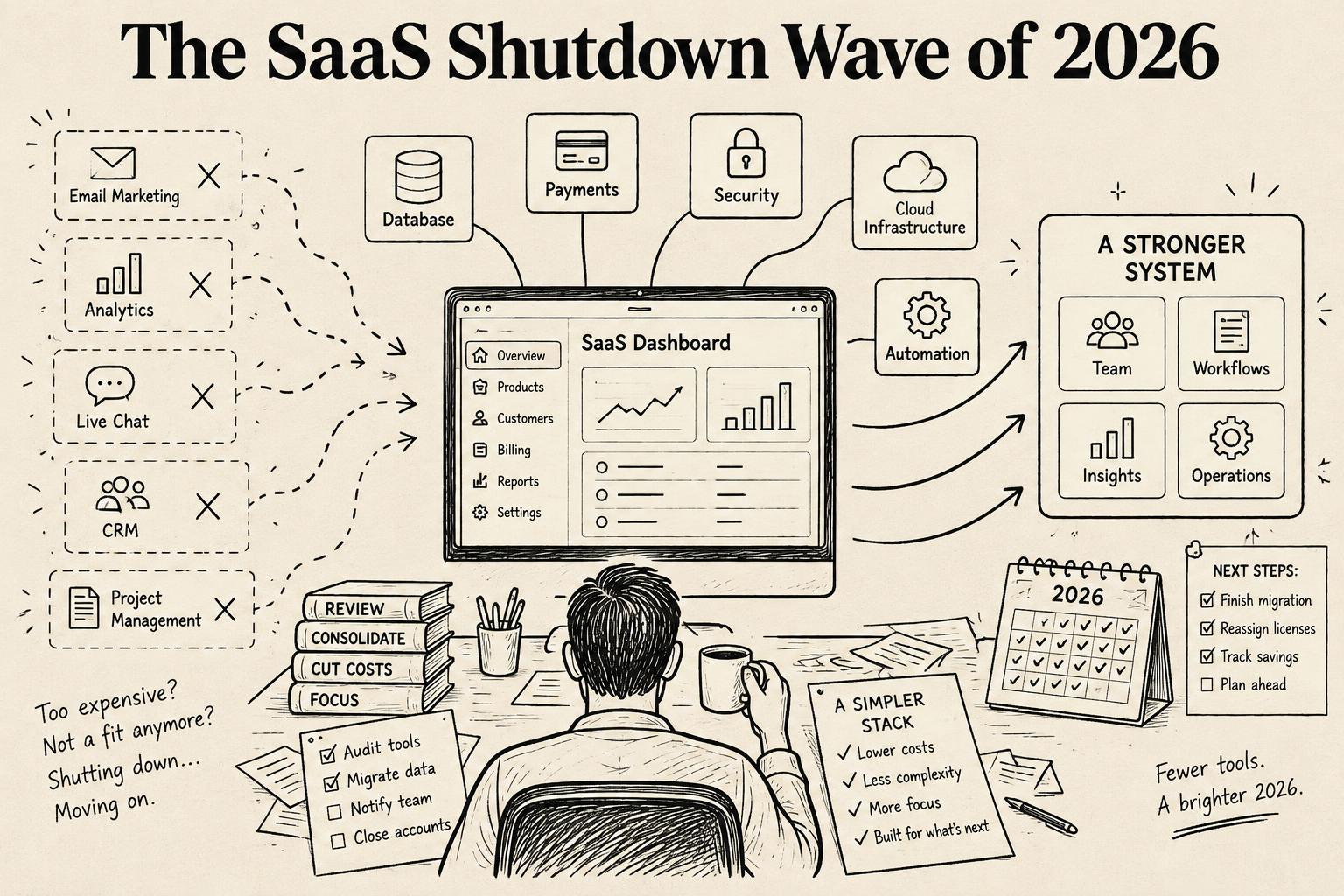
The SaaS Shutdown Wave of 2026: Mantle, Gadget, Lemon Squeezy and the Reality of Building Software Businesses
Mantle, Gadget, Lemon Squeezy, Relay, Rows, Notion Mail and Zeabur: 2026 has brought major SaaS shutdowns, wind-downs and product sunsets. Here is what founders and customers should learn about sustainability, platform risk and building resilient software businesses.
By Yuvraj Kewate · 2026-11-17
There is something unsettling about watching products you have used, recommended, built around, or followed for years announce that they are shutting down.
In 2026, the SaaS ecosystem has had more than its share of those announcements, from SaaS companies shutting down entirely to products being retired by their parent companies.
Mantle has wound down. Gadget has announced that its platform will be discontinued. Lemon Squeezy is being wound down by Stripe. Relay has shut down. Rows and Notion Mail have been discontinued. Zeabur has announced a wind-down following a security incident.
These are not all the same story. Some are independent products being retired. Some are platforms being consolidated into a parent company's broader product strategy. Some are businesses closing. Some are services being wound down after a security event.
But they all leave users with the same uncomfortable question:
What happens to the businesses that depend on software when that software disappears?
For founders, there is another question worth asking:
If a product has customers, revenue, a strong community and a technically impressive platform, what does it actually take to keep the business alive?
2026 is reminding SaaS founders that building a good product and building a sustainable business are two very different things.
A product can be loved and still be commercially difficult to sustain. A platform can be technically excellent and still carry operational risks that make it hard to run. A company can have a strong parent behind it and still decide that a product no longer fits its priorities.
This is not an article about SaaS dying. Software is not going away. The opportunity to build useful software is not disappearing either.
It is an article about the less glamorous part of building software: business models, customer concentration, infrastructure, security, platform dependency, operating costs, strategic focus and the responsibility that comes with becoming part of someone else's workflow.
Let's look at what happened, what the situations have in common, and what founders and customers should take away from them.
1. Mantle: When an entire ecosystem has to find a new home
Mantle's wind-down is particularly relevant to the Shopify app ecosystem.
Mantle announced on June 16, 2026 that it would completely wind down its products. Most Mantle services ended on August 14, 2026, while customers using Mantle Billing had until September 30, 2026. We covered the announcement and its immediate impact in Issue 29 of our Shopify App Founders newsletter.
For years, Mantle served Shopify app developers with tools for subscriptions, customer management, analytics, affiliate programs and other operational workflows. It became part of the infrastructure that some app businesses relied on to manage their operations.
When a platform like Mantle announces that it is winding down, the impact is not limited to the company itself.
Its customers have to reconsider systems that may be deeply connected to their daily operations. They have to evaluate alternatives, migrate data, recreate workflows, communicate changes to partners and make sure that nothing important gets lost in the transition.
Affiliate and referral programs are a good example.
A Shopify app founder may have spent years recruiting affiliates, building relationships with agencies and consultants, distributing referral links, tracking conversions and managing commissions. That information is not just a collection of records. It represents relationships and future revenue.
Moving from one platform to another is therefore not simply a matter of exporting a CSV and importing it somewhere else.
Founders need to think about:
- Existing affiliate and partner records.
- Referral links already shared across the internet.
- Historical referrals and attribution data.
- Commission structures and outstanding balances.
- Payout history and reconciliation.
- Partner-facing dashboards and signup pages.
- Communication with affiliates about the transition.
- The risk of losing attribution during migration.
This is where a shutdown becomes an ecosystem problem.
The platform may be closing, but the businesses that depended on it still need to operate.
What Mantle users should consider next
For Shopify app founders who used Mantle primarily to manage affiliate and partner programs, PartnerDock is one option worth evaluating.
PartnerDock is an affiliate and partner management platform built specifically for Shopify app businesses. It is designed around the workflows that Shopify app founders need when working with affiliates, agencies, consultants and other referral partners.
It supports:
- Partner registration and self-serve enrollment.
- Branded partner signup pages.
- Unique referral links and referral attribution.
- Revenue-share commissions.
- Fixed commissions per install.
- Fixed first-month commission structures.
- Partner dashboards and referral reporting.
- Payout reconciliation and manual payout tracking.
- Multi-app management for organizations running more than one Shopify app.
The platform also offers a hands-on migration path for former Mantle users. Its migration documentation explains the process for moving affiliate and referral information, including historical records, and describes how existing Mantle links can continue working through the transition.
Founders evaluating a migration should review the details directly rather than assume that every workflow or integration will transfer automatically.
Useful resources:
PartnerDock is built by the team behind SaaSOri. We are introducing it because Shopify app founders need reliable infrastructure for partner and affiliate programs, including when the platform they previously depended on is no longer available.
The wider lesson from Mantle is simple: when a SaaS product becomes part of another company's revenue operations, the cost of shutting it down extends far beyond the product itself.
A platform's customers are not just users. They are businesses with dependencies, relationships and obligations.
2. Gadget: The risk of building your business on someone else's platform
Gadget's announcement is another important moment for software founders, particularly those building Shopify apps and other web applications.
Gadget offered a development platform that brought together several parts of the application-building process. Developers could build application logic, work with data, connect services and deploy applications without having to assemble every piece of infrastructure themselves.
For teams that adopted it, Gadget was more than a development tool. It could become the foundation on which their applications operated.
That is what makes a platform wind-down so consequential.
If a developer uses a design tool and that tool disappears, they may be able to export their work and continue elsewhere.
If a developer uses a managed application platform, the situation is much more complicated.
The platform may be responsible for parts of the runtime, database, authentication, hosting, integrations, deployment process and application infrastructure. Those dependencies have to be understood before a migration can begin.
Gadget announced its wind-down on November 9, 2026, with the platform expected to remain available until March 31, 2027. New applications can no longer be started, first-time production deploys are allowed until the end of November, and Gadget support remains available until the end of 2026.
That gives affected developers a transition period, but it does not make migration trivial.
A developer cannot assume that moving source code is equivalent to moving a working production application.
What developers need to audit before migrating
If your application depends on a managed platform, start by documenting the complete architecture.
1. Application code
Identify where your application logic lives, how it is organized and whether you can export the complete source code.
2. Database and data models
Document the database structure, relationships, indexes, permissions and stored records. Export the data and test that it can be restored somewhere else.
3. Authentication and permissions
Understand how users, sessions, roles, permissions and application credentials are managed. Authentication is often tightly coupled to the platform.
4. Background jobs and scheduled tasks
List every recurring job, queue, scheduled function and asynchronous process. These can be easy to overlook because they may not be visible in the main application interface.
5. API integrations
Document every external service, webhook, API connection and credential. Check which integrations are native to the platform and which ones will need to be recreated.
6. Hosting and deployment
Identify how the application is built, deployed, scaled and monitored. You need a replacement deployment process, not just a copy of the source code.
7. Environment variables and secrets
Make a secure inventory of environment variables, API keys, database credentials, signing secrets and other configuration. Rotate credentials when appropriate during migration.
8. Production testing
A migration is not complete when the application starts. Test authentication, billing, webhooks, data operations, background jobs, integrations and the workflows customers actually use.
Could Lovable be an alternative?
For developers evaluating what to use next, AI application builders are naturally part of the conversation.
One product worth exploring is Lovable.
Lovable is an AI-powered application builder that helps people create web applications through natural-language instructions. It can help generate application interfaces and code, iterate on functionality and connect applications to backend services and databases.
For founders who want to move quickly, prototype a replacement interface or build a new application from a different starting point, it is worth evaluating.
However, there is an important distinction.
Lovable is not a direct, one-to-one replacement for Gadget's managed application platform.
Gadget provided a more integrated managed environment for building and operating applications. Lovable is an AI-assisted application-building approach. A production migration still requires decisions about hosting, database infrastructure, authentication, integrations, deployment, monitoring, security and ongoing maintenance.
In other words, using an AI builder does not automatically solve the infrastructure problem created by a platform shutdown.
It may help you rebuild parts of the application faster. You still need to decide where and how the application will run.
Disclosure: This is a referral link. We may receive a benefit if you sign up through it.
The bigger lesson from Gadget
Gadget's wind-down highlights a question every founder should ask before adopting a managed platform:
If this platform disappeared tomorrow, how much of my business could I take with me?
That does not mean founders should avoid managed platforms. They can save enormous amounts of engineering time and allow small teams to build products that would otherwise require much larger teams.
The issue is not using a platform. The issue is failing to understand the dependency.
Before building a business on top of any third-party platform, understand what you own, what the provider operates, what you can export and what it would take to move.
Convenience is valuable. Portability is valuable too.
3. Lemon Squeezy: When a product is folded into a larger strategy
Lemon Squeezy's wind-down is a different kind of story.
Lemon Squeezy built a strong reputation as a merchant-of-record platform for software businesses, creators and digital product sellers. It simplified parts of online selling that can otherwise become difficult for small teams, particularly payments, tax and compliance.
It was acquired by Stripe in 2024. The November 16, 2026 announcement explains that Lemon Squeezy is now winding down as Stripe focuses on its Managed Payments product.
According to the company's announcement:
- New store sign-ups have been closed.
- Lemon Squeezy will stop processing payments on March 31, 2027.
- Migration tooling for Stripe Managed Payments is expected to become available on December 2, 2026.
- Businesses that cannot move to Managed Payments will need to evaluate another provider.
- Customers are being asked to plan their migration before the March 31 deadline.
The company's stated reasoning is strategic consolidation. Stripe says it wants to focus on one product rather than continue operating two separate platforms, reducing duplicated work across engineering, security and compliance.
This is not the same as a standalone startup running out of money.
It is a parent company deciding that two overlapping products should not continue operating independently.
That distinction matters.
From the customer's perspective, the impact is still real. They have to move payment operations, review supported features, plan subscription migration and make sure customers are not affected.
The merchant-of-record dependency problem
A merchant-of-record provider can become deeply embedded in a digital business.
It may handle:
- Payment processing.
- Sales tax and VAT calculations.
- Tax collection and remittance.
- Subscription billing.
- Refunds and disputes.
- Customer payment records.
- Checkout and payment methods.
- Compliance responsibilities.
Changing providers can therefore be more complicated than changing a payment button.
Founders should review:
- Whether the new provider supports their country and business structure.
- Whether existing subscriptions can be migrated.
- Whether payment methods and customer payment details can be transferred.
- Whether tax handling changes.
- Whether refunds, disputes and chargebacks remain accessible.
- Whether digital delivery and storefront features need separate services.
- Whether checkout, pricing and billing flows will change for customers.
One particularly important detail in Lemon Squeezy's announcement is that Stripe Managed Payments is not a like-for-like replacement for every feature. The company specifically notes that features such as digital fulfillment and storefronts may require separate tools.
That is exactly the kind of detail founders should examine before migrating.
A familiar brand name does not guarantee that every part of the previous product will continue to exist in the new one.
Read the company's announcement and migration guidance:
What founders should learn
An acquisition can create opportunities for customers, teams and technology. It can also lead to product consolidation.
When a product is acquired, customers should not assume that its roadmap, pricing, features or independent existence are guaranteed.
If the product is important to your business, monitor acquisition announcements and product strategy changes. Keep exports current and understand your exit options before you need them.
4. Relay: When a useful product loses its reason to exist
Relay was an AI-powered workflow automation product that positioned itself as an alternative to traditional automation platforms.
It helped users connect workflows, automate tasks and use AI agents to handle parts of their work.
Relay announced its closure in July 2026. Free users lost access on August 15 and paid customers on September 14, 2026, and TechCrunch reported that founder Jacob Bank and some of the team were joining Google's Chrome team. The closure came as larger platforms were adding similar automation and AI agent capabilities directly into their own products.
That is a difficult competitive environment for an independent SaaS company.
A product can be useful. Customers can like it. The team can execute well. But if the underlying capability becomes a standard feature of platforms customers already use, the independent product has to answer a harder question:
Why should someone pay for a separate product when the same capability is becoming part of their existing software?
This is not unique to AI.
It has happened across many software categories:
- Email tools competing with features built into email platforms.
- Scheduling products competing with calendar-native features.
- Analytics tools competing with features built into commerce platforms.
- Automation products competing with workflow capabilities added to existing business software.
- Collaboration products competing with features bundled into larger productivity suites.
AI makes the problem more visible because product capabilities are changing quickly.
A workflow that required a dedicated product a year ago may become a native feature in a much larger platform.
The distribution problem
Independent SaaS products often compete with more than another startup.
They compete with the distribution, customer relationships and bundled pricing of much larger companies.
A small company might build a better standalone experience. But a platform with millions of existing users can introduce a similar feature and put it in front of customers immediately.
That changes the economics of acquisition and retention.
The independent product needs to keep proving that it offers something meaningfully better:
- More reliable workflows.
- Deeper integrations.
- Better control and customization.
- Stronger collaboration features.
- Better observability and debugging.
- A specialized experience for a specific industry.
- A clear return on investment.
If the product's only advantage is that it performs a task that larger platforms are rapidly making free or native, the business becomes vulnerable.
The lesson from Relay
Do not build a SaaS business around a feature that can be copied and bundled without thinking about what makes the product defensible.
A feature can be a great starting point. It is not automatically a durable business.
The stronger question is whether the product becomes a system customers rely on because of its data, workflow depth, integrations, expertise, community or measurable business outcomes.
5. Rows: A product sunset is not always a company failure
Rows is an important example because its story is different from a conventional shutdown.
Rows built a modern spreadsheet product with integrations, data workflows and collaboration features. It attracted users who wanted something more connected and flexible than a traditional spreadsheet.
In February 2026, Superhuman agreed to acquire Rows. Rows said it would gradually sunset the product, with Rows.com fully winding down on May 31, 2026.
That is an acquisition, not simply a failed SaaS company shutting down.
The distinction is important because the product's standalone future and the team's future are not necessarily the same thing.
A product can be discontinued because the acquiring company wants to bring its capabilities, people or technology into a broader product strategy.
For customers, the practical questions are still familiar:
- Will the product continue to operate?
- Will existing users have a migration path?
- What happens to integrations?
- Can data be exported?
- Will pricing or access change?
- Which features will survive in the acquiring company's product?
For founders, the lesson is that an acquisition does not guarantee that the product customers originally bought will continue indefinitely.
The buyer may value the team, technology, customer base or strategic capabilities more than the standalone product.
A successful exit for a company does not always mean continuity for the product.
That is why customers should evaluate the actual product transition rather than assume that an acquisition is automatically good or bad news.
6. Notion Mail: Even large product ecosystems have to make hard choices
Notion Mail was Notion's attempt to bring email into its broader productivity ecosystem.
It was an interesting proposition: email, tasks, organization and AI-assisted workflows in a connected environment.
But in June 2026, Notion announced that it was winding down Notion Mail, with the inbox shutting down on September 22, 2026. Notion said more than half of Notion Mail users were managing email without ever opening the inbox, and that it would focus on agents that run the inbox instead.
The important part of this story is not that Notion is struggling as a company. It is that even a large, well-known software company can decide that a product is not worth continuing as a standalone offering.
A company with a successful core product may experiment with adjacent categories. Some experiments become important products. Others do not earn enough adoption or strategic priority to justify continued investment.
This is normal product portfolio management.
But it is also a reminder that customers should distinguish between the stability of a company and the stability of an individual product.
A company can be doing well while one of its products disappears.
The lesson for product builders
A product does not deserve indefinite investment simply because it has launched, attracted attention or has an interesting roadmap.
Teams need to evaluate:
- Active usage.
- Retention.
- Frequency of use.
- Customer willingness to pay.
- Cost to maintain.
- Strategic fit with the company's core product.
- Whether the product improves the wider ecosystem.
Shipping a product is a milestone. Sustaining it requires a different level of commitment.
7. Zeabur: Security is not a feature you can postpone
Zeabur's situation is a different kind of warning.
Zeabur is a developer platform used to deploy and manage applications. On October 17, 2026, Zeabur announced that it was winding down, shortly after its second security incident in two months. All dedicated servers and shared clusters are scheduled to stop operating by December 31, 2026.
In its follow-up on the October incident, Zeabur said credentials stored on the platform, such as API keys, were exposed, and that under its current financial circumstances it could not pay third-party service charges arising from the incident.
A security incident and a product shutdown are not interchangeable events. The existence of an incident does not, by itself, tell us everything about the cause of a company's decision to wind down.
But the situation does highlight a reality that every software founder needs to take seriously:
Security is part of the product, and the ability to operate securely is part of the business.
For developer platforms, the stakes can be particularly high.
Customers may rely on a platform to run production applications, store data, manage credentials, connect services and handle workloads. A compromise can affect more than one application or account.
The consequences may include:
- Customer data exposure.
- Credential theft.
- Unauthorized access.
- Service interruption.
- Loss of customer trust.
- Incident response costs.
- Legal and compliance obligations.
- Increased infrastructure and security costs.
- Long-term reputational damage.
Security is often treated as an engineering checklist. In reality, it is an operating discipline that affects customer confidence, retention and the cost of running a software business.
Why Shopify app founders should pay attention
The Shopify app ecosystem has its own version of this risk.
Shopify apps often have access to sensitive merchant data, storefront functionality, order information, customer records and administrative workflows. A vulnerability in an app or its infrastructure can have consequences beyond the app developer.
In October 2026, the Shopify ecosystem saw reported security incidents involving malicious storefront scripts and fake checkout pages. These incidents brought renewed attention to the risks created by third-party app code, exposed credentials and inadequate security controls.
The important distinction is that these incidents should not be described as Shopify's own checkout infrastructure being compromised. The concern was around third-party app code, configurations and credentials that could affect merchant experiences.
We covered the broader issue in our article:
Shopify App Security in 2026: What Merchants and App Developers Need to Know
That article looks at the October incidents, the security risks for merchants and developers, and the practical steps Shopify app businesses should take.
Shopify's response: Security requirements are becoming more concrete
Shopify has been making security expectations more explicit for app developers.
The changes announced in 2026 include several important areas.
1. IP allowlisting for public apps
Shopify is requiring public apps to configure IP allowlists for Admin API access. For a step-by-step walkthrough, see our Shopify IP allowlist setup guide.
The purpose is to restrict API access to known network origins rather than leave access open to requests from arbitrary locations.
The requirement has important deadlines:
- Public apps must configure IP allowlists by November 20, 2026. Apps without one will be delisted from the Shopify App Store and blocked from new installs.
- Apps using bulk operations have an earlier November 12, 2026 deadline.
- Shopify's November updates also cover custom apps installed outside the owning organization: an IP allowlist is required for new installs from November 20, 2026 and for existing installs from January 1, 2027.
Developers should check the current Shopify documentation for the exact requirements that apply to their app type and installation model.
2. Support for IP addresses and ASNs together
Shopify updated the allowlist implementation to support a combination of static IP addresses and Autonomous System Numbers (ASNs).
The updated limits and behavior are important for applications running on cloud infrastructure where outbound traffic may originate from multiple network ranges.
The November 11 update describes support for up to 250 IP addresses or ranges and 10 ASNs. It also explains how matching works when multiple entries are configured.
This matters because a developer who only allowlists one hosting provider may unintentionally block legitimate requests that originate from another infrastructure provider.
3. Expiring offline access tokens
Shopify has also been moving toward expiring offline access tokens.
Apps need to understand the new token lifecycle, handle refresh and reauthorization correctly, and avoid assuming that offline credentials will remain valid indefinitely.
This is not just a security configuration change. It can affect application architecture and background processes.
4. App security checks
Shopify provides security checks and guidance to help developers identify potential issues before they become incidents.
Developers should run the relevant checks, review warnings and make security validation part of their normal development and release process.
5. Stronger partner account protection
Account security matters too. Access to a developer or partner account can be just as consequential as a vulnerability in the application itself.
Shopify has also communicated stronger expectations around account protection, including multi-factor authentication on all partner accounts.
Official resources:
- Shopify IP allowlist documentation
- IP allowlists are now required for public apps
- IP addresses and ASNs can now be used together
- Shopify's app security updates and what is required next
- Shopify app security documentation
- Using expiring offline access tokens
- Securing your app, together
A practical security checklist for Shopify app developers
The policy changes are important, but compliance should not be the only reason to review application security.
Every Shopify app team should be able to answer the following questions.
Network access
- Have we configured the required IP allowlist?
- Have we identified every legitimate outbound network origin?
- Are we accounting for cloud providers and third-party services?
- Have we tested the allowlist against production traffic?
- Are we monitoring blocked requests after enabling it?
Credentials and tokens
- Are we handling expiring offline access tokens correctly?
- Are credentials stored securely?
- Do we rotate credentials when required?
- Are secrets accidentally exposed in logs, source code or client-side bundles?
- Do we have a process for revoking compromised credentials?
Application permissions
- Do we request only the scopes we actually need?
- Do we understand what merchant and customer data the app can access?
- Are permissions reviewed when product functionality changes?
- Are we handling protected customer data according to Shopify's requirements?
Infrastructure and deployment
- Do we know where production workloads run?
- Do we have access controls for deployment environments?
- Are databases and backups protected?
- Are dependencies regularly updated?
- Do we have monitoring for unusual activity?
Incident response
- Do we know how to identify a security incident?
- Who is responsible for responding?
- Can we revoke credentials quickly?
- Can we communicate with affected merchants?
- Do we have a recovery and restoration process?
For merchants, the takeaway is equally important: evaluate the security practices of the apps you install, understand what data they access and remove apps that are no longer needed.
A platform's reputation cannot replace an assessment of the individual apps and services connected to your business.
The lesson from Zeabur
Security is not something a small SaaS company can postpone until it becomes large.
The earlier a business builds sound security practices into its product and operations, the easier it is to maintain customer trust as it grows.
The cost of security work is visible. The cost of not doing it can be much larger.
8. Nvidia: A different kind of risk, but a useful reminder about concentration
Nvidia does not belong in a list of SaaS products that shut down. Its November 2026 story is a separate example of how leadership, governance, geopolitical exposure and dependence on a central figure can affect a technology business.
But it is relevant to the wider conversation about risk in the software and technology ecosystem.
In November, reporting around Nvidia CEO Jensen Huang described a controversy involving his personal relationships, a business executive named Alice Huang, alleged connections to Chinese intelligence and questions about chip shipments to China.
The situation prompted scrutiny from US officials and political figures. Huang told employees that he had been unfaithful to his wife, and Nvidia's board opened an independent investigation into whether he had been the target of a foreign intelligence effort. The board said it had no reason to believe that national security or Nvidia secrets had been compromised.
On November 12, Nvidia announced that Huang had resigned as president, CEO and a member of the board, with CFO Colette Kress serving as interim CEO.
The allegations and national-security questions remain matters of investigation and reporting. They should not be treated as established findings simply because they have been widely discussed.
The story is significant for another reason: it demonstrates how much risk can become concentrated around a company, its leadership and its position in a critical technology supply chain.
Nvidia is central to the AI infrastructure market. Its chips are used across major AI workloads, and its business has become closely connected to the investment decisions of cloud providers, AI companies and data-centre operators.
When a company occupies such a central position, events affecting its leadership or business relationships can have consequences well beyond its own organization.
This is not a direct comparison with a small SaaS startup. The scale and nature of the businesses are very different.
But there is a useful parallel for founders.
Concentration creates risk.
A business that depends too heavily on one customer, one distribution channel, one platform, one infrastructure provider or one individual can become vulnerable when that dependency changes.
For a small SaaS company, that might mean:
- One customer accounts for most of its revenue.
- One marketplace provides nearly all new users.
- One cloud provider hosts every production workload.
- One API provider controls a critical product capability.
- One founder holds all technical and commercial knowledge.
- One acquisition partner is responsible for a major growth channel.
The Nvidia story is a reminder that even companies operating at enormous scale are exposed to governance, leadership and ecosystem risks.
For smaller founders, the lesson is not to avoid dependence altogether. It is to understand where the dependencies exist and how much damage a disruption could cause.
9. The common thread: A great product is not the same as a durable business
Look at these stories together and it becomes clear that there is no single explanation for every shutdown.
Mantle's wind-down affects an ecosystem of Shopify app businesses.
Gadget's decision affects developers whose applications depend on its managed platform.
Lemon Squeezy is being consolidated into Stripe's broader payments strategy.
Relay shut down in a market where larger platforms were adding overlapping capabilities.
Rows joined Superhuman, illustrating how an acquisition can change the future of a standalone product.
Notion Mail was discontinued as part of product portfolio decisions.
Zeabur's wind-down followed a second security incident in two months.
Nvidia's situation is a separate leadership and governance story, not a SaaS product shutdown.
These are different situations. But they point to a set of questions every founder should be asking.
9.1 Revenue is not the same as sustainability
A SaaS product can have paying customers and still struggle to become a sustainable business.
Revenue alone does not tell you whether the company can support its operating costs, infrastructure, engineering team, customer support, security requirements, compliance obligations and future development.
A business needs to understand its economics at a much deeper level.
For example:
- How much does it cost to acquire a customer?
- How long does that customer stay?
- How much does it cost to serve that customer?
- How much support does each account require?
- How much revenue comes from the largest customers?
- How much engineering work is needed to maintain the product?
- How much cash is required to operate through a difficult quarter?
A product can look healthy from the outside while the business underneath it is under pressure.
9.2 Platform dependency can become a strategic liability
Building on top of another platform is often the right decision.
Shopify app developers build on Shopify. SaaS companies use Stripe, AWS, Supabase, Google Cloud and dozens of other services. Startups use managed platforms because they need to move quickly.
The mistake is assuming that those platforms will always remain available, affordable or strategically aligned with your business.
A founder should understand:
- What happens if the provider changes pricing?
- What happens if an API is deprecated?
- What happens if a platform changes its terms?
- What happens if a service is acquired?
- What happens if a product is discontinued?
- How much of the application can be moved elsewhere?
- How long would a migration take?
You do not need to build every component yourself. You do need to understand what happens when a critical dependency changes.
9.3 Distribution can matter more than features
Many founders spend most of their time improving the product.
That is understandable. Product quality matters.
But a product without a repeatable distribution strategy can become difficult to sustain.
A competitor with a larger customer base can bundle similar functionality. A marketplace can change its ranking algorithm. A platform can introduce a native feature. Paid acquisition can become more expensive.
A durable SaaS business needs to know how it will consistently reach customers.
That may come from:
- Organic search.
- Partnerships.
- Integrations.
- App marketplaces.
- Communities.
- Referrals.
- Content and education.
- Product-led growth.
- Direct sales.
- Industry-specific distribution.
The strongest businesses do not rely on a single channel that they cannot control.
9.4 Security and compliance are operating costs
Security is often treated as something to invest in after product-market fit.
That is a dangerous assumption for products that handle customer data, payments, credentials or production workloads.
As a product grows, its responsibilities grow too.
Security reviews, monitoring, access controls, incident response, compliance and infrastructure maintenance all cost money and engineering time.
They are not optional extras for a serious software business.
They are part of the cost of delivering the product.
9.5 Product strategy requires saying no
Notion Mail is a reminder that a company cannot pursue every product opportunity forever.
Every product creates an ongoing commitment:
- Engineering.
- Design.
- Support.
- Infrastructure.
- Security.
- Documentation.
- Integrations.
- Customer communication.
A product that does not fit the company's long-term strategy may eventually be discontinued, even if the company itself is healthy.
Founders should be deliberate about what they build and why.
The goal is not to launch the largest number of features. It is to build a product portfolio that the business can actually support.
9.6 Customer trust is an asset that takes years to build
When a SaaS company shuts down, its users are left with work they never planned to do.
They have to migrate data, change workflows, find alternatives, communicate with their own customers and manage the risk of disruption.
The way a company handles a shutdown matters.
A responsible wind-down should include:
- Clear communication.
- Realistic deadlines.
- Data export options.
- Documentation.
- Migration support where possible.
- Transparent explanations of what will and will not continue.
- A clear date for when access ends.
- A plan for outstanding payments and obligations.
A company may not be able to continue operating forever. But it can still treat its customers responsibly when it decides to stop.
10. What SaaS founders should do before their own platform becomes a dependency
The best time to plan for a platform shutdown is before one is announced.
Here is a practical checklist for founders.
Review your business dependencies
List every third-party service that your product depends on.
Include infrastructure, databases, authentication, payment processing, analytics, email delivery, AI models, marketplaces and integrations.
For each one, record:
- What it does.
- How critical it is.
- What data it stores.
- What happens if it becomes unavailable.
- Whether an alternative exists.
- How difficult migration would be.
Make data portability a product requirement
Do not wait until a vendor announces a shutdown to think about data exports.
Know what data you can export, how frequently you can export it and whether it is usable outside the platform.
Test the export and restoration process.
A backup that has never been restored is an assumption, not a recovery plan.
Document the architecture
Keep a current architecture document that explains:
- Application components.
- Data storage.
- Authentication.
- External APIs.
- Webhooks.
- Background jobs.
- Hosting and deployment.
- Secrets and environment variables.
- Monitoring and alerting.
This documentation should not exist only in the head of one developer.
Understand your unit economics
Calculate the actual cost of serving customers.
Include infrastructure, third-party APIs, payment fees, support, refunds, compliance, engineering maintenance and acquisition costs.
Know which customer segments are profitable and which ones consume more resources than they generate.
Reduce revenue concentration
A business that depends on one large customer or one partner can be vulnerable even if the revenue looks impressive.
Diversify revenue sources where practical.
Do not let one customer, channel or integration become an unexamined single point of failure.
Create a shutdown and migration plan
This may sound pessimistic, but it is responsible product management.
If your company had to wind down, how would customers export their data? How much notice could you provide? What would happen to their subscriptions? Which integrations would stop working? Who would handle support?
Having a plan does not mean you expect to fail.
It means you understand your responsibility to the people who trust your product.
11. What customers should learn from the 2026 SaaS shutdowns
This conversation is not only for founders.
If you run a business and rely on SaaS products, the announcements of 2026 are a reminder to review your own software stack.
Start with the products that are most critical to revenue or daily operations.
Ask:
- What would happen if this product stopped working tomorrow?
- Can I export all the data I need?
- Do I have access to historical records?
- Are my integrations documented?
- Can I move to another provider without rebuilding everything?
- Do I know the contract, cancellation and data-retention terms?
- Does the vendor have a clear incident and shutdown communication process?
For important systems, keep a record of:
- Vendor name and support contact.
- Subscription and renewal details.
- Data export instructions.
- API and integration dependencies.
- Business owner responsible for the tool.
- Potential replacement options.
- Recovery steps.
You do not need to maintain a backup vendor for every small tool. But for systems that control payments, customer records, operations or revenue, you should know what your fallback plan looks like.
12. The opportunity for new SaaS founders
It would be easy to look at all these announcements and conclude that building SaaS products has become too risky.
That is the wrong conclusion.
Every shutdown creates disruption. It also reveals unmet needs.
When a platform disappears, customers still have the underlying problem. They still need to manage partners, deploy applications, process payments, automate workflows and protect their data.
The opportunity is not simply to build another version of the product that disappeared.
It is to understand why customers depended on it, what they valued, what was missing and what a more sustainable alternative could look like.
The next generation of SaaS products may be smaller, more specialized and more focused on clear business outcomes.
They may use AI to reduce the cost of building and maintaining software. They may rely on managed infrastructure to keep teams lean. They may serve narrower customer segments rather than trying to become the next horizontal platform.
But the fundamentals remain.
Customers need a reason to pay. The product needs a reason to exist. The business needs enough margin to keep operating. The team needs to be able to support what it sells.
AI can make it faster to build software. It does not automatically make a software business sustainable.
A faster development cycle does not solve customer acquisition. A generated interface does not create retention. A prototype does not become a reliable production service without infrastructure, security, support and ongoing ownership.
The opportunity is still there. The discipline required to build a lasting business has not disappeared.
13. The uncomfortable question every founder should ask
There is a pattern in the 2026 announcements, but it is not that every SaaS company is failing.
It is that the software industry is full of products whose future depends on forces outside the product itself.
A parent company can change its strategy. A platform can change its policies. A competitor can bundle the same capability. Infrastructure can become more expensive. A security incident can change customer trust. A product can lose strategic priority.
None of these risks can be eliminated entirely.
But they can be understood, measured and managed.
If you are building a SaaS company today, ask yourself:
- Are customers paying for a real business outcome or just a feature?
- Can we acquire customers repeatedly without relying on one channel?
- Do we understand our actual cost to serve?
- Are we building something difficult to replace?
- Can customers take their data with them?
- Are our critical dependencies documented?
- Can the business survive a major platform or pricing change?
- Are we investing in security before a crisis forces us to?
- Can the company operate without one individual holding all the knowledge?
These questions are not as exciting as a product launch or a funding announcement.
But they are often what separate a product that gets attention from a business that lasts.
Final thoughts: Building software is easy to celebrate. Building a business is harder.
The 2026 SaaS shutdowns are not proof that the software business is broken.
They are reminders that the industry has always had two separate challenges.
The first is building something people want.
The second is building an organization that can keep delivering it.
Mantle, Gadget, Lemon Squeezy, Relay, Rows, Notion Mail and Zeabur each tell a different story. Their circumstances should not be reduced to one simplistic explanation. Some are strategic decisions. Some are product sunsets. Some are platform wind-downs. Some involve serious operational or security challenges.
But every announcement leaves customers and founders with a version of the same question:
How much of your business depends on something you do not control?
The answer should shape how you choose infrastructure, build integrations, manage data, design your business model and communicate with customers.
For founders, the lesson is not to stop building.
It is to build with a clearer understanding of the business behind the product.
Because building a good product and building a sustainable business are two very different things.
And in the long run, you need both.